
Please click on the tabs below to view our curriculum information.
Curriculum Intent Statement
At Egerton, we are ambitious for all children to Learn personal, social and academic skills and knowledge, Achieve their potential in all aspects of their lives and Aspire to bright futures both in careers and relationships in the modern world we live in.
When children secure a place at our school, we firmly believe that they belong at Egerton, and in belonging here, every child is given the opportunity to succeed.
The teaching of an ambitious curriculum is at the heart of all we do in order to foster a deep love of learning. Learning involves a lasting change in pupils’ capabilities or understanding. The word ‘involves’ is used because we recognise that learning is a very complex process. We know that learning occurs in a variety of ways, and we understand that pupils have only learnt something if they have integrated it into their long term memory thus resulting in a change of capability and understanding which couldn’t previously be demonstrated.
Our unique curriculum is an enhancement of the National Curriculum and through its delivery we ensure that key knowledge, skills, values and cultural capital are embedded into the opportunities that we provide for our children. The school sustains the delivery of a broad and rich curriculum ensuring that children make progress in that they know more, remember more and are able to do more.
Our broad and rich curriculum is progressive and builds on prior knowledge and skills. We ensure that all learning builds towards an end point. Teachers ensure that pupils are well-prepared for their next stage of education at each stage of their learning. Pupils are ready for the move to their next year group at the point they leave their current class.
As well as wanting our best for the children within the classroom, we also want to make sure that our children learn to be positive members of society, who treat others with respect and contribute to the community in a responsible manner. We place high-priority on the children’s well-being, and constantly work on developing their spiritual, moral, social and cultural citizenship. We want all of our children to be aware of, and celebrate, the diversity in the society in which they live, and prepare them for life in the wider world. Through embedding British Values within our curriculum, we hope for children to appreciate the importance of equal opportunity and fairness to all.
We pride ourselves on ensuring that all children will be confident, articulate and effective communicators by the time they leave our school. Through our curriculum, we want all our children to develop a strong work ethic, both individually and collaboratively. We challenge our children to think, make links with their learning and the world around them and take their love of learning beyond the classroom.
Our goal for all our children is to ensure they access an aspirational curriculum, deeply rooted in an understanding of the learning process, which ensures they are successful in modern 21st Century Britain.

Curriculum Implementation Statement
At Egerton, we want all of our staff to be the best that they can be. Our staff are life-long learners, and we strive to instil this passion in our children by ensuring that teachers have excellent curriculum subject knowledge that they present clearly in the classroom, using the highest standards of communication.
Staff therefore require a deep understanding of the learning process and have developed teaching methods based on this understanding.

The simple model of memory provides useful insights about how people learn. This is a simplified model which focuses our attention on the most important elements of how learning happens and therefore can support decision making about the implementation of teaching for learning at Egerton. The model demonstrates that we have two areas of memory. Working memory and long term memory. Learning results in a change of capability and understanding which couldn’t previously be demonstrated therefore it requires information to be effectively stored in long term memory. The process of learning is the journey of information from our environment to the long term memory. It may be factual e.g. knowing the 6 wives of Henry V111 or procedural e.g. an individual’s knowledge of how to do long division.
The model starts with the environment. This is the world around us and is filled with information. We can’t pay attention to all of this information so we only learn what we attend to. Therefore in our classrooms at Egerton, it is vital that the environment reinforces and directs attention to the content which we want children to learn – our display policy details this further. This information we pay attention to is stored in our working memory. We acknowledge that working memory has limits and therefore the content we articulate is presented in small manageable steps.
This knowledge can be forgotten and therefore, within our teaching, we find opportunities to strengthen it so it is remembered within pupils’ long term memory. We do this through creating opportunities for revisiting knowledge and skills through practise and retrieval. – see Rosenshine’s 10 principles for instruction below.
Through our teaching we provide opportunities for pupils to remember prior knowledge and transfer it to their working memory. This in turn supports new information and builds on knowledge in long term memory. This is learning – it is effortful and takes time.
It’s important to keep in mind that this model is based on a neuro-typical learner. Egerton is an inclusive schooland for some children in our classrooms, learning may look slightly different or takes longer and this is expected. Some children will not be able to hold as much in their working memory or for as long, which may lead to them forgetting more frequently. Some children will need to revisit information more frequently to help them remember it. It is our job to provide an inclusive classroom, which focuses on the right teaching for all children. More information can be found in our SEND Local offer.
Rosenshine’s Ten Key Principles
Barak Rosenshine (1930 – 2017) was a professor in the Department of Educational Psychology at the University of Illinois. He explored teacher instruction, and he identified the approaches and strategies that were the features of the most successful practice. His research was based on
1.How the brain acquires new information
2.The classroom practices of teachers whose children demonstrate the highest gains
3.Findings from studies that taught learning strategies to children.
Rosenshine’s ten principles of instruction provide us at Egerton with strategies to regularly
use in lessons to enable effective learning to occur. Our approach of teaching for learning relies on these principles to be used effectively across curriculum subjects.
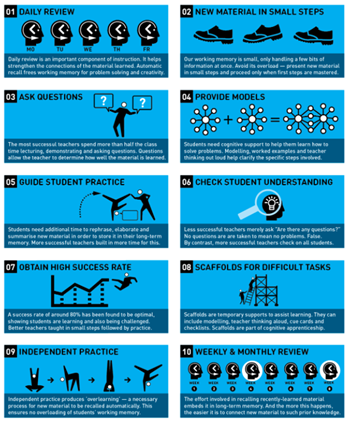
At Egerton, these principles are applied within all curriculum lessons in all year groups, and are shown in research to have the most impact on pupils’ outcomes.
They should be well planned for a particular purpose and embedded in the sequential teaching process and should not be used as a tick list process for the design of a lesson.
Our Sequenced and Progressive Curriculum
From EYFS all the way through to Year Six, well-sequenced teaching of curriculum subjects builds on prior knowledge and skills. Knowledge organisers ensure that teaching is focused on key content, vocabulary and skills. Fluency tasks across the curriculum allow for opportunities for children to commit key content to long term memory.
Tasks presented to children ensure that the high expectations and aspirations for our pupils are reflected. Tasks in all subjects match the well-sequenced curriculum on offer and provide children with the opportunity to present and discuss content cumulatively.
We know how important it is for all children to read fluently to be able to access all subject areas. We prioritise this from an early age to make sure that all children can access the curriculum. A well-sequenced and progressive synthetic phonics programme, based on Letters and Sounds, is embedded through EYFS and KS1 ensuring children get ahead with their reading fluency. The teaching of phonics progressively is well matched to appropriate reading books that children access.
Performance Vs Learning Having high expectations for pupils ensures that children articulate their knowledge and apply skills effectively. However, we must not confuse performance with learning. Monitoring of lessons and work at Egerton demonstrates that pupils perform well in work completed and tasks set. However, this performance is not the same as learning albeit a
necessary part of the process. It is quite possible that a pupil may demonstrate they know something by the end of a lesson but have forgotten it by the next lesson. In order to ensure a lasting change in knowledge or behaviour, we must promote and support learning over time by revisiting content multiple times to consolidate understanding. This means that learning is much harder to pinpoint than performance, and while we can infer from performance, we can’t rely on it as a sole indicator of learning.
Assessment of our pupils’ knowledge is timely and focused. Teachers are skilled at using formative assessment to support pupil’s retrieval of curriculum content and check understanding at the point of teaching. Formal assessment points allow for rigor in the discussion of teaching and learning and pupil’s cognitive load.
We know the impact trips and visitors can have on supporting and enhancing children’s learning experiences, and we look to provide ample opportunities, which support children’s curriculum content at the point of learning, every year for this to take place.
Metacognition and Motivation
Metacognition is often described as learning to learn and motivation is the willingness to engage metacognition skills.
Teaching metacognition approaches has the potential to have a significant impact on pupil learning. At Egerton, we have explicitly set out our approach to metacognition within our Learn, Achieve, Aspire mission statement and have broken this down into values for teachers to model and children to refer to. This is particularly effective when applied to challenging tasks rooted in curriculum content.
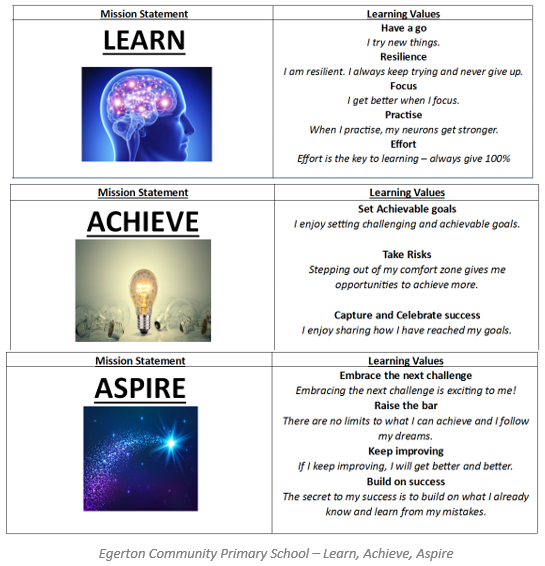
We encourage children to take responsibility for their own learning by evaluating their own learning strategies– what helps them learn and what makes it difficult for them to learn. We follow the Education Endowment Foundation guidance on implementing metacognition strategies by including
- Explicit teaching of metacognitive strategies
- Teacher modelling of their own thinking to demonstrate metacognition strategies
- Opportunities for children to reflect on and monitor their strengths and areas for improvement, and plan how to overcome current difficulties.
- Providing enough challenge for learners to develop effective strategies, but not so difficult that they struggle to apply a strategy.
We ensure these strategies are embedded in the school curriculum and are bespoke to the specific subject lesson. For example, planning and evaluating a piece of diary writing would require different metacognitive skills to evaluating methods for solving a mathematical reasoning problem.
Curriculum Impact Statement
A focused environment enables attention to be paid to small manageable steps that builds on prior knowledge and can be processed in the working memory.
Due to the well-sequenced and the progressive nature of our curriculum, children regularly revisit concepts and link ideas together, thus retrieving knowledge from the long term memory back into working memory.
Therefore, children know more, can remember more and do more in all subjects across the curriculum.
Due to teachers delivering subject content sequentially, pupils’ knowledge in all subject areas is well-developed.
Across the curriculum, pupils are able to learn skills in order to achieve and aspire to further success in all subject areas.
Excellence in early reading, progression in fluency and acquisition of comprehension skills means that Egerton pupils develop a love of reading across the curriculum.
School evaluation and school development consistently evaluates the curriculum impact and adapts processes.
Pupil’s achievements in statutory testing is consistently in line or above the national averages.
All pupils move onto the next stage of their education with the knowledge, skills and citizenship to LEARN further, ACHIEVE their goals and ASPIRE to their future success.
For more information on the curriculum content at Egerton CP School, please contact us on 01204 333530 and ask to speak to our Curriculum Co-ordinator Mr C Pilling
